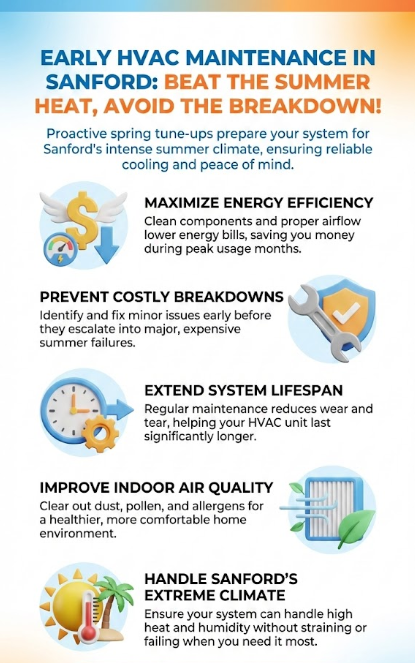
After servicing thousands of HVAC systems across Seminole County, we've noticed a clear pattern: the units that fail during July's peak heat are almost always the ones that skipped spring maintenance. It's not coincidence—it's physics. Sanford's combination of high humidity, afternoon thunderstorms, and months of nonstop runtime creates stress that exposes small problems fast.
What we've learned from working in Central Florida specifically is that timing matters as much as the maintenance itself. Systems checked in February or March give technicians room to order parts, address wear patterns, and test performance before emergency season hits. By June, most local HVAC companies are running two-week backlogs of no-cool calls—and that's when a failing capacitor or low refrigerant charge turns from a minor fix into days without air conditioning.
This guide shares what our technicians look for during early-season tune-ups and why Sanford's climate demands a proactive approach to summer cooling reliability.
TL;DR Quick Answers
What should Sanford homeowners know about HVAC maintenance?
Best timing: Schedule service between late January and mid-April—before summer backlogs and peak-season pricing.
Why it matters here: Sanford's climate demands more from cooling systems than most U.S. regions. Expect 90°+ temperatures, 70%+ humidity, and five to six months of near-continuous operation.
What we've learned locally:
Systems serviced in spring rarely appear on our summer emergency list
A $150 tune-up prevents $600+ breakdown repairs
Clogged condensate drains cause more preventable damage than any other issue
Minimum maintenance checklist:
Annual professional inspection
Monthly filter checks during peak cooling season
Clear debris from outdoor condenser unit
Monitor for unusual sounds or reduced airflow
Before hiring a contractor:
Verify active license through Florida DBPR
Confirm they pull required City of Sanford or Seminole County permits
Check BBB complaint history
Available savings:
Duke Energy rebates: up to $1,000
Federal tax credits: up to $2,000 (expires December 2025)
Bottom line: Early maintenance isn't optional in Central Florida—it's how Sanford homeowners avoid mid-summer failures when technician availability drops and repair costs spike.
Top Takeaways
Schedule maintenance January through April — Maximum technician availability and lead time before summer demand peaks
Sanford's climate accelerates HVAC wear — 90°+ temps, 70%+ humidity, and five months of continuous operation push systems harder than national averages
Early repairs cost less than emergency fixes — A $150 spring repair often becomes $600+ in July, plus three to five days without AC
Verify contractor credentials first — Confirm licensing through Florida DBPR and check BBB complaint history before authorizing work
Stack available incentives — Duke Energy rebates up to $1,000, federal tax credits up to $2,000 (expires December 2025), plus duct repair programs
How Sanford's Summer Conditions Push HVAC Systems to the Limit
Central Florida's climate ranks among the most demanding for residential cooling equipment in the country. Sanford typically sees 90°+ temperatures from May through September paired with humidity levels exceeding 70 percent—forcing air conditioners to run 12 to 16 hours daily just to maintain comfort. That sustained operation accelerates wear on capacitors, contactors, and coils far faster than moderate climates.
Add Sanford's afternoon thunderstorm pattern and the stress compounds. Frequent power surges weaken electrical components while post-storm humidity spikes force systems to recover under the worst possible conditions. Equipment that entered summer with marginal parts often can't handle these back-to-back demands.
Early maintenance catches these vulnerabilities when technicians have time to test thoroughly, source parts without delays, and make repairs before your system faces real stress. What costs $150 to fix in March often becomes a $600 emergency repair in August—assuming you can get a technician to your home within a few days during peak breakdown season.
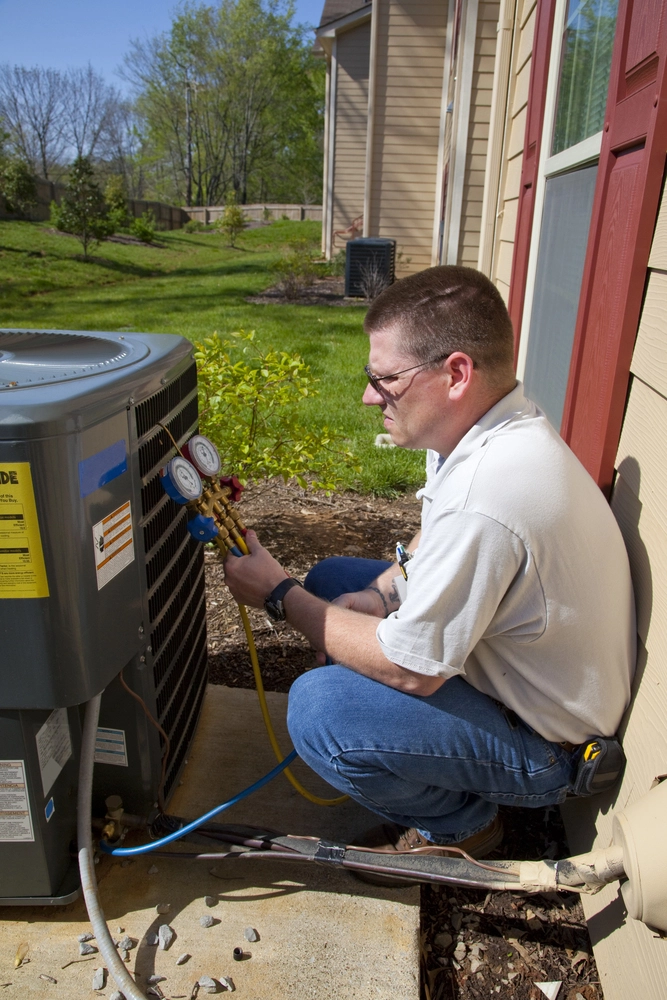
"In our experience, about 80 percent of the emergency no-cool calls we handle in July trace back to issues we could have caught during a spring tune-up—worn capacitors, low refrigerant, clogged drain lines. Sanford homeowners who schedule maintenance before April almost never end up on our emergency list when temperatures peak."
Essential Resources for Sanford HVAC Maintenance Decisions
Making informed decisions about HVAC maintenance and contractor selection in Sanford requires access to official documentation, verification tools, and available incentive programs. These seven resources provide Sanford homeowners with everything needed to verify credentials, ensure code compliance, and maximize available savings.
Verify Contractor Licensing Through Florida DBPR
Confirm any HVAC contractor holds a valid, active state license before authorizing work. The Florida Department of Business and Professional Regulation database allows searches by company name or license number and displays current license status, expiration dates, and any disciplinary actions.
Resource: Florida DBPR License Verification Portal URL: https://www.myfloridalicense.com/intentions2.asp
Confirm Permits Through City of Sanford Building Division
Florida law requires licensed contractors to obtain building permits for HVAC installations, replacements, and major repairs. The City of Sanford's online portal allows homeowners to verify permits were filed, track inspection status, and access submittal requirements for any project within city limits.
Resource: City of Sanford Building Division URL: https://sanfordfl.gov/government/development-services/building-division/
Access Seminole County Permit Records for Unincorporated Areas
Properties outside Sanford city limits fall under Seminole County jurisdiction for permitting and inspections. This portal provides permit applications, contractor registration verification, and inspection scheduling for residents in unincorporated Seminole County.
Resource: Seminole County Building Division URL: https://www.seminolecountyfl.gov/departments-services/development-services/building
Claim Up to $1,000 in Duke Energy HVAC Rebates
Duke Energy serves the Sanford area and offers substantial rebates for qualifying high-efficiency HVAC replacements, duct repairs, and attic insulation upgrades. Homeowners must complete a free Home Energy Check before work begins to qualify for most incentive programs.
Resource: Duke Energy Home Energy Improvement Program URL: https://www.duke-energy.com/home/products/home-energy-improvement
Maximize Federal Tax Credits Before December 2025
The federal Energy Efficient Home Improvement Credit provides up to $2,000 for qualifying heat pump installations and $600 for high-efficiency central air conditioners. These credits expire December 31, 2025, making timely system upgrades financially advantageous for Sanford homeowners planning replacements.
Resource: ENERGY STAR Federal Tax Credits Guide URL: https://www.energystar.gov/about/federal-tax-credits
Follow Official HVAC Maintenance Guidelines Between Service Visits
ENERGY STAR's maintenance checklist outlines homeowner tasks that preserve system efficiency and extend equipment lifespan—including monthly filter inspections, condensate drain monitoring, and coil cleaning schedules. Following these guidelines reduces emergency repair likelihood and supports warranty compliance.
Resource: ENERGY STAR HVAC Maintenance Checklist URL: https://www.energystar.gov/saveathome/heating-cooling/maintenance-checklist
Research Contractor Reputation Through BBB Complaint History
Before hiring any HVAC company, review their Better Business Bureau profile for complaint patterns, resolution rates, and accreditation status. BBB records reveal how contractors handle disputes, respond to customer concerns, and maintain service standards over time.
Resource: Better Business Bureau Contractor Search URL: https://www.bbb.org
Supporting Statistics
Industry research confirms the maintenance patterns we observe daily across Seminole County—proactive service delivers measurable returns in efficiency, equipment lifespan, and cost savings.
System Efficiency Losses
Neglected HVAC systems lose 5% to 15% efficiency annually according to the U.S. Department of Energy, which reports heating and cooling represents 43% of residential energy consumption nationwide.
What we see locally:
Central Florida's extended runtime demands accelerate these losses beyond national averages
Systems operating 12 to 16 hours daily during summer accumulate wear faster
Skipped spring maintenance correlates directly with higher July and August utility bills
Source: U.S. Department of Energy – Heating and Cooling https://www.energy.gov/energysaver/heating-and-cooling
Equipment Lifespan Impact
ENERGY STAR data shows maintained systems last 15 to 20 years while neglected equipment typically fails within 10 to 12 years.
What we see locally:
Florida's humidity accelerates corrosion and component fatigue beyond temperate climates
Units receiving consistent spring maintenance routinely outlast neglected systems by five years or more
Lifespan difference represents $5,000 to $15,000 in avoided early replacement costs
Source: ENERGY STAR – Heating & Cooling Maintenance https://www.energystar.gov/saveathome/heating-cooling
Regional Energy Costs
U.S. Energy Information Administration data confirms Florida households spend $1,912 annually on electricity—12% above the national average—with air conditioning driving majority consumption.
What we see locally:
Customers scheduling pre-April maintenance consistently report lower peak-season bills
Efficiency difference between tuned and marginal systems: $15 to $30 monthly during summer
Seasonal savings typically exceed the cost of a pre-summer inspection
Source: U.S. Energy Information Administration – State Electricity Profiles https://www.eia.gov/electricity/state/florida/
Final Thought
Early HVAC maintenance in Sanford isn't about following a calendar—it's about understanding how Central Florida's specific conditions affect cooling equipment and timing service accordingly.
The systems that run reliably through August and September are almost always the ones that received attention in February or March. That's the predictable result of catching worn capacitors, low refrigerant, and clogged drain lines before they become failures under peak summer load.
Our Perspective
After years of servicing HVAC systems across Seminole County, we've noticed patterns the statistics don't fully capture.
Timing matters more than most homeowners realize.
A $150 capacitor replacement in March often becomes a $600 emergency repair in July
Peak-season service delays mean three to five days without air conditioning
Minor issues left unaddressed frequently cascade into compressor damage
Sanford's climate demands a different maintenance mindset.
National guidelines assume moderate cooling seasons—Central Florida delivers five to six months of sustained high-demand operation
Humidity accelerates corrosion faster than manufacturer estimates account for
Afternoon thunderstorms stress electrical components repeatedly throughout summer
Equipment here ages faster than homeowners expect
The real value of early maintenance is optionality.
Spring inspections provide time to:
Budget for necessary repairs without emergency pressure
Schedule part replacements before summer backlogs develop
Evaluate system upgrades with full information rather than rushed decisions
Confirm equipment reliability before peak cooling demand arrives
Once July arrives, options narrow considerably.
Proactive maintenance isn't about preventing every possible failure. It's about shifting the odds in your favor—ensuring that when Sanford's summer heat peaks, your system has already proven it can handle the demand.
FAQ on “HVAC Maintenance in Sanford”
Q: How often should I schedule HVAC maintenance in Sanford?
A: We recommend professional maintenance at least once annually, scheduled between late January and mid-April.
What we've observed locally:
Sanford's extended cooling season stresses equipment beyond national guidelines
Systems older than eight years benefit from biannual inspections
Spring and fall tune-ups prevent the majority of mid-summer failures we see
Q: What does a typical HVAC tune-up in Sanford include?
A: Our technicians work through a systematic inspection covering four key areas:
Electrical components — Capacitor strength, contactor condition, wiring integrity
Refrigerant evaluation — Charge levels, leak detection
Airflow assessment — Coil cleaning, blower motor operation
Drainage inspection — Condensate line clearing
The drainage check is particularly critical in Sanford. High humidity means systems generate substantial moisture, and clogged drain lines cause more preventable water damage calls than any other single issue.
Q: Do I need a permit for HVAC work in Sanford?
A: Yes—this is non-negotiable under Florida law.
Key points:
Licensed contractors must obtain permits for installations, replacements, and major repairs
City of Sanford Building Division handles permits within city limits
Seminole County oversees unincorporated areas
Unpermitted work can void manufacturer warranties
We've seen homeowners face complications during home sales when permit records don't match installed equipment. If a contractor suggests skipping permits, consider it a red flag.
Q: How much does HVAC maintenance cost in the Sanford area?
A: Standard tune-ups typically range from $75 to $200 depending on system type and service scope.
Why maintenance agreements often make sense:
Reduced annual rates compared to individual service calls
Priority scheduling during peak season
Non-contract wait times stretch three to five days in summer
Scheduling priority especially valuable for elderly residents or medical considerations
Q: Are there rebates available for HVAC upgrades in Sanford?
A: Yes—the current incentive landscape is unusually favorable.
Available programs:
Duke Energy rebates — Up to $1,000 for qualifying high-efficiency replacements
Federal tax credits — Up to $2,000 for heat pumps (expires December 2025)
Additional incentives — Duct repair and insulation programs
Here is the nearest branch location serving the Hobe Sound FL area…
Duke Energy rebates — Up to $1,000 for qualifying high-efficiency replacements
Federal tax credits — Up to $2,000 for heat pumps (expires December 2025)
Additional incentives — Duct repair and insulation programs
Filterbuy HVAC Solutions - West Palm Beach FL
1655 Palm Beach Lakes Blvd ste 1005, West Palm Beach, FL 33401, United States
(561) 448-3760
https://maps.app.goo.gl/AiRzEnWDJCmsKBvi7